
Billing Investigation Workspace
How understanding the agent's decision process simplified an entire investigation.
Lead Product Designer | Focus: Enterprise CRM • Billing • B2B2C • SaaS platform
The Challenge
Billing investigations were designed around business processes rather than the decisions agents needed to make.
The Solution
Shifted the experience from process-driven screens to a decision-oriented investigation workspace that helps agents validate hypotheses and evaluate resolution options in context.
The Outcome
Reduced cognitive load, minimized context switching, and enabled faster, more confident customer resolutions while keeping the final decision with the agent.
The Business Problem
One of the most common telecom support calls is "Why is my bill so high?" - Billing investigations typically require agents to gather information from multiple systems, compare usage with entitlements, identify unusual activity, and determine the most appropriate resolution.
The challenge wasn't finding the data—it was connecting it quickly enough to make a confident decision.
What I discovered
Through observations and workflow mapping, I realized the investigation wasn't a sequence of business steps.
Agents constantly formed and validated hypotheses while moving between disconnected systems, making the process slower and mentally demanding.
This shifted my thinking: instead of optimizing individual screens, I needed to design around the decisions agents were trying to make.

The Design Thinking
Rather than designing separate screens for each business step, I asked a different question: What does an agent need to make a confident decision?
The investigation wasn't about following a process - it was about validating hypotheses, understanding the customer's situation, and choosing the right resolution.
This led me to design a single contextual workspace where agents could:
-
Compare usage against entitlements
-
Validate investigation hypotheses
-
Review anomalies in context
-
Evaluate resolution options without losing focus
I also explored how we can bring recommend next best actions for common billing scenarios while leaving the final decision to the agent.
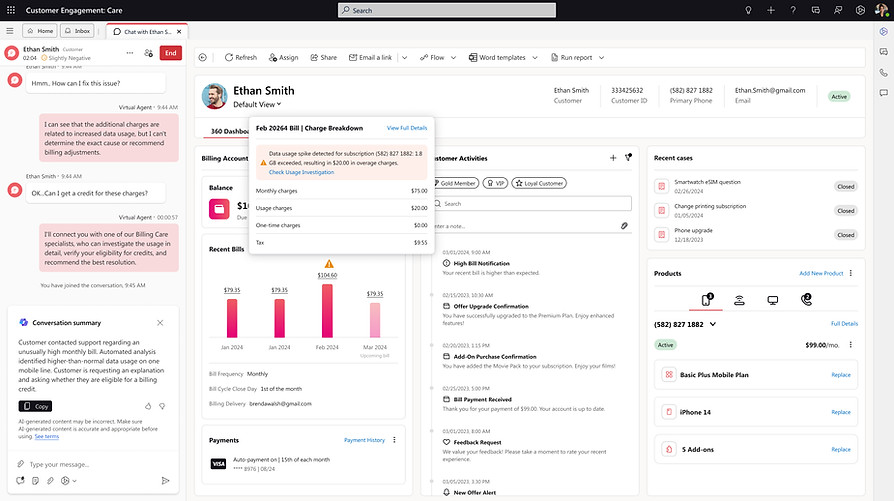
Customer 360. Every investigation starts with context. Customer 360 provides an instant view of the customer's profile and highlights unusual billing activity, giving agents the information they need to begin their investigation with confidence.
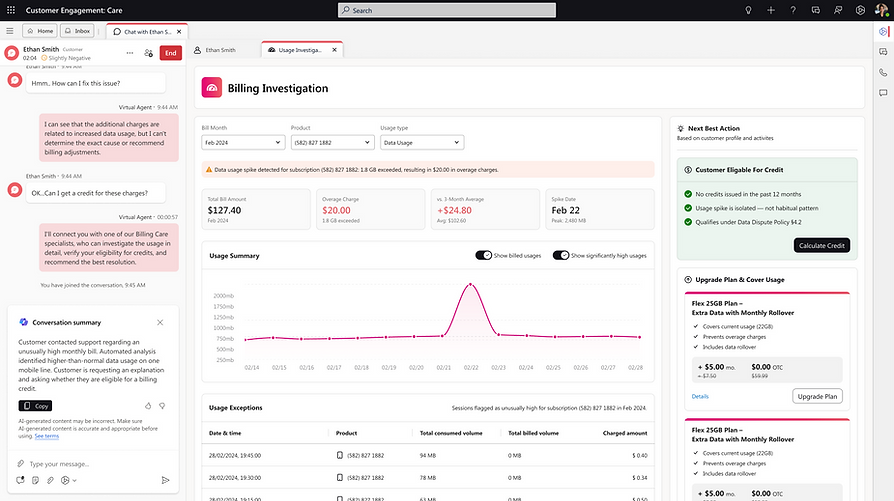
Investigation Workspace. Investigation Workspace. A single contextual workspace combines billing data, usage insights, anomalies, and resolution options. AI recommends the next best actions, while agents make the final decision.
Design Highlights
1. Progressive Evidence
Surface only the information needed to validate the next decision, reducing cognitive load while building confidence throughout the investigation.
2. Context Before Action
Establish a complete customer and billing context before recommending credits, upgrades, or other resolution options.
3. Decision-Centered Workflow
Organize information around the decisions agents need to make, rather than the underlying business process or system structure.
.
4. Decision Support
Prioritize the most relevant next-best actions while keeping the final decision in the hands of the agent.

Design Insight
Enterprise workflows often become complex because they're optimized around business processes instead of the decisions users need to make.
Designing around the questions users need answered - not the steps the system expects them to follow—creates experiences that are simpler and more effective. Reframing the billing investigation as a decision journey naturally led to a single contextual workspace where agents could focus on solving the customer's problem rather than navigating the system.
About CEP, My Role & Results
Amdocs Customer Engagement Platform (CEP) is a telecom CRM platform co-developed with Microsoft Dynamics 365. As Lead Product Designer, I led the UX strategy for the platfrom and the Billing domain, helping transform one of telecom's most complex customer care scenarios into a guided investigation experience.
This Billing Investigation experience was designed as part of Amdocs Customer Engagement Platform (CEP), a joint initiative with Microsoft Dynamics 365 to create a unified telecom CRM ecosystem supporting customer care, sales, commerce, and operational workflows.
Beyond this workflow, I helped define scalable UX foundations, reusable interaction patterns, and a consistent experience across multiple products and teams.
Following the CEP deployment at PLDT, the platform contributed to measurable operational improvements:
-
48% reduction in Tier 1 resolution time
-
50% fewer agent screens
-
2,000 hours of customer waiting time eliminated
-
27-point NPS improvement for the targeted use case


